
Guide
Soy-free, corn-free pork: what our hogs actually eat
Our hogs get a non-GMO ration with no corn and no soy in it, plus forest forage and hay, which is rare in American pork and changes some things but not all.
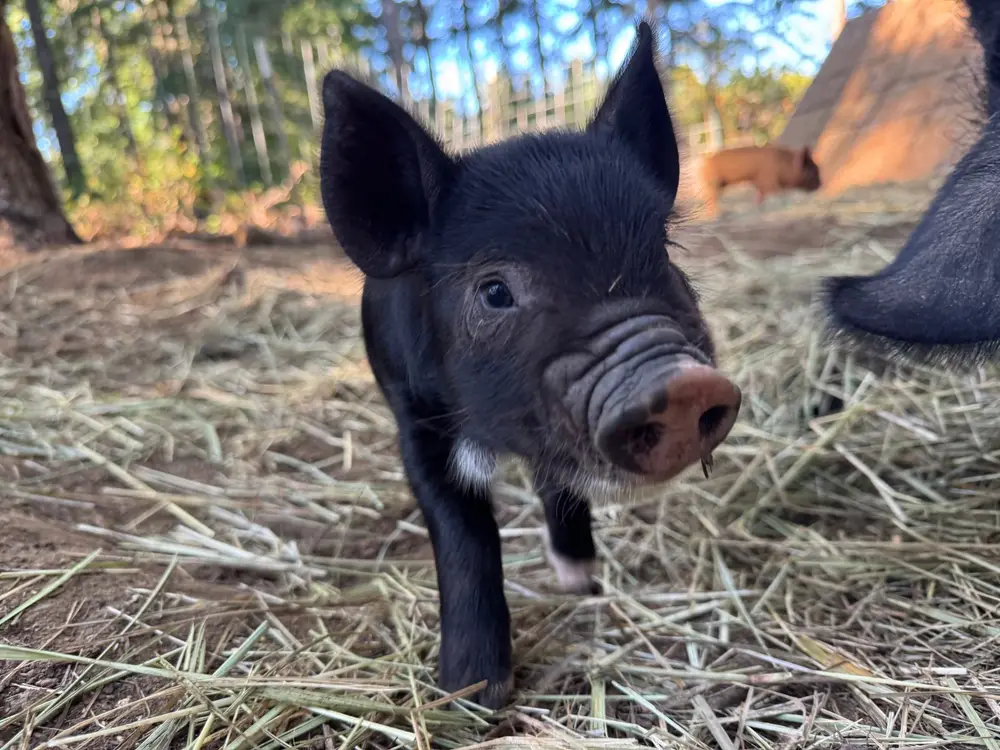
Our hogs eat a non-GMO ration with no corn and no soy in it, plus what they graze and root up in the woods, plus hay. Almost no pork in the United States is raised that way, and that includes most pork sold as pasture raised.
Below is what commercial pigs eat, what ours eat instead, and what that does and does not change. If you avoid soy for an allergy, read the last part first.
What almost every pig in America eats
Corn and soybean meal. That is not a summary. It is close to the literal ingredient list.
A published example grow-finish diet runs 72.7% corn and 23.9% soybean meal for a pig of 45 to 90 pounds, shifting to 83.1% corn and 14.3% soybean meal by 180 to 225 pounds. That document calls the two the sole sources of energy and amino acids in the base formulation. The rest of the bag is minerals, vitamins and crystalline amino acids.
It starts earlier than people expect. A phase one nursery diet, fed from weaning at roughly 12 pounds, commonly carries soybean meal at 16 to 18%, often with a specialty soy protein on top. A commercial hog eats soy from weaning to the day it ships. About 97% of US soybean meal goes into animal feed, 38.05 million short tons in 2023.
“Pasture raised” does not change this. USDA’s Food Safety and Inspection Service has decided not to write animal raising claim definitions into its regulations, so the phrase is backed by whatever documentation a plant files. It describes where an animal stands. It carries no feed requirement.
Why corn and soy won
Not a conspiracy. Chemistry and price.
Corn is the cheapest energy. Soybean meal is the cheapest lysine. Dehulled soybean meal runs 45 to 48% protein and 2.8 to 3.0% lysine at only 8 to 9% fiber, and its amino acid profile fills in almost exactly what corn is short on. Two ingredients, one complete diet, at the lowest cost per pound of gain anyone has found.
Take those out and the diet has to be rebuilt from more expensive parts. That is the barrier, and it is why the claim is rare.
What you have to use instead
| Ingredient | Energy vs corn | Protein | Lysine | The catch |
|---|---|---|---|---|
| Barley | 95 to 105% | 12.7% | 0.46% | Higher fiber, pigs eat more to compensate |
| Wheat | 100 to 115% | 13.3 to 16.0% | 0.37 to 0.43% | Unpalatable if ground too fine |
| Field peas | 65 to 75% | 25.6% | 1.69% | Low methionine and tryptophan, 20 to 35% max |
| Dried whey | 130 to 150% | 12.6% | 0.94% | Expensive and awkward to handle |
Field peas come closest, at 1.69% lysine, but only 20 to 35% of a grower diet can be peas. Nothing on that list is a drop-in, which is the point.
Then price. Practical Farmers of Iowa put barley at $4.53 a bushel against corn at $3.27 in October 2018. The numbers are old. The direction is not.
Our ration is non-GMO, with no corn and no soy in it, and it costs more. There is no version of this where it does not.
The woods, the hay, and the breed
Most pigs turned out on grass are standing on it. Idaho Pasture Pigs were bred to eat it.
The breed is a cross of Old Berkshire, Duroc and Kunekune, developed by Shelly Farris in Rigby, Idaho, and released to the public in 2012. The registry’s breed standard calls for a medium length snout with an upturn or dish on the end, to allow grazing and discourage rooting. Straight snouts root. Dished snouts graze.
Three facts, one argument:
- The breed grazes, so grass is food and not bedding.
- The ration has no corn and no soy, so forage is the diet and not decoration.
- Rooting the understory is how more grazing gets created.
Our eight acres are going from woodland to pasture, and the pigs are doing the work. They work the understory over, grass comes in behind them, and then they graze it. The rooting is how the grazing gets made.
What forage can and cannot do
A pig is not a cow. Fiber digestion happens almost entirely in the large intestine, takes an adaptation period of at least two months, and the forage has to be young to be worth much.
The published numbers are honest about the limits. Growing pigs do acceptably on diets up to 20% alfalfa, but expect a 5 to 15% drop in feed efficiency against a grain and soybean meal diet. Push forage to 400 pounds per ton in a finishing ration and growth falls 5 to 10% while feed to gain rises 10 to 15%. Gestating sows carry far more.
Even a grazing breed needs grain. The figure usually given for Idaho Pasture Pigs is 10 to 20% of the diet as grain and minerals, because grass does not supply enough lysine.
This is where we do the opposite of what the extension literature advises. Those papers treat the forage penalty as a cost to minimize. We pay it on purpose, because the pigs clear land while they eat, and that work never shows up in a feed conversion number.
Does the soy in feed end up in the meat? Probably not
This is where a lot of farms would let you assume something. We will not.
There is no good evidence that allergenic soy protein from feed survives digestion and turns up in muscle. Dietary protein is broken to amino acids, absorbed as amino acids, and rebuilt into the animal’s own tissue. The beef industry’s research arm says exactly that, and cites work on grain-fed cattle where no gluten residue was detectable in muscle.
Two caveats we owe you. That statement is about cattle, which have a rumen a pig does not have, and it comes from an industry group with an interest in the answer. We found no equivalent published testing on pork.
What does carry over is smaller than a protein. Soy isoflavones from feed are measurable in animal products, mostly milk and eggs, and in pigs daidzein and equol have been recovered from tissue. Isoflavones are not the proteins that cause soy allergy. If they are your question, feed matters. If allergy is your question, this is not that evidence.
So, plainly: with a diagnosed soy allergy, ask your allergist, not a farmer. Soy allergy affects roughly 0.4% of US infants, most outgrow it by age 10, and four adult surveys average near 3 in 1,000. Soy must be declared on a US food label, which means most of the soy risk in pork sits downstream of the animal, in cure mixes, sausage binders and seasonings. That is a processing question, not a pasture question, and the ingredient statement answers it.
Our hogs are processed under USDA inspection at Windy N Ranch in Ellensburg, establishment M47898, under our own label, so every package carries one. Why that matters is in our guide to USDA and custom exempt pork.
What the diet does change: the fat
Here is what is genuinely defensible.
A pig lays down the fat it eats, more or less as it eats it. Absorbed fatty acids, especially polyunsaturated ones, suppress the pig’s own fat synthesis, so carcass fat ends up looking like feed fat. That is why the industry measures iodine value, an index of unsaturation, and caps it near 70 to 75 grams per 100 grams to keep fat firm enough to handle.
Forage pulls the same lever. Practical Farmers of Iowa compared pork from grain-free, half-grain and full-grain diets against store-bought pork. The omega-6 to omega-3 ratio came in at 29.4 for the store sample, 13.8 on full grain, 9.9 at half grain and 5.2 with no grain at all. Omega-3 as a share of total fat ran the other way, 0.67% in the store sample against 2.82% grain-free.
Read it with the authors’ warning attached. The lab reported group means only, which ruled out statistics, and it is one small study. A direction, not a number for a package.
We have not had our own pork tested. If we do, we will publish what comes back.
Ten months, not six
A commercial hog reaches butcher weight around six months. Idaho Pasture Pigs on a mostly grass diet take about ten to reach 230 to 250 pounds.
Four extra months of feed and care, on a ration that costs more per pound, on an animal that hangs lighter at the end. That is the honest reason this pork costs more than the store.
Who this is actually for
- People who keep corn and soy out of their own diet and want the animal fed the same way. No caveat needed here.
- People who want the fat that comes from forage rather than grain. Defensible, with the study limits above.
- People with a diagnosed soy allergy. Read the ingredient statement and ask your allergist. The feed is not where your risk sits.
If you are in that first group, this is one of very few places out here to buy pork without reading a label and hoping.
First boxes come out in late October. Sampler is $57, Grill is $83, Farm is $155, and the contents are on the pork page. How the animals live is on how we farm.