
Guide
What Is in Season on the Key Peninsula, Month by Month
Cool summers push tomatoes weeks later than most charts say, and a first frost that often waits until late November keeps dahlias going long after a national calendar ends them.
Short version. On the Key Peninsula the cool season is long and the warm season is short and late. Greens, peas and brassicas run well from March into June and again from September into winter. Tomatoes and peppers do not really arrive until late summer, and then they run into October. Dahlias start in July and keep going until the first frost, which here is more often late November than September.
If you print a national seasonality chart and drive out by it, you will show up early for tomatoes and a month late for flowers.
Why the standard charts are wrong for this water
Three things about this microclimate break the usual calendar.
The summer is cool and short. At Olympia, the nearest station with a long official record, the normal August high is 79°F and the normal August low is 52°F, and only 6.3 days a year reach 90°F (NOAA 1991 to 2020 normals). Nights in the low 50s all summer are what hold tomatoes back, not the daytime highs. WSU is blunt about it: many warm season crops “require a longer growing season or warmer temperatures than are available west of the Cascade Mountains” (WSU Extension).
The first frost is very late. NOAA’s freeze records for Gig Harbor, the closest station with published probabilities, put a coin flip on whether the first 32°F night has arrived by November 21. About one year in five it holds off past December 2, and nine years in ten it has landed by December 10 (NOAA NCEI via Garden.org). That is why dahlias run so long here.
The spring is long, wet and cold. WSU’s western Washington calendar gives a last frost of “late March here in USDA Zone 8” (WSU Extension), but the NOAA numbers still put the median last 36°F night around April 11, with a 10 percent chance of one as late as May 2. Cold wet soil, not the frost date, is what actually decides when you can plant.
Lakebay sits in USDA hardiness zone 8b, average annual extreme low of 15 to 20°F (USDA 2023 Plant Hardiness Zone Map, ZIP 98349). Mild winter, cool summer. Good for kale, hard for melons.
One honest caveat on all of it. Those frost numbers come from Gig Harbor. The Key Peninsula is more rural and has more low ground for cold air to settle in, so a hollow can frost a week or two before an open slope a mile away.
Wildwood Hollow’s own calendar
| What | When it is usually ready here |
|---|---|
| Vegetable and flower starts | February to May, out of the hoop house |
| Dahlias and zinnias | Midsummer to first frost |
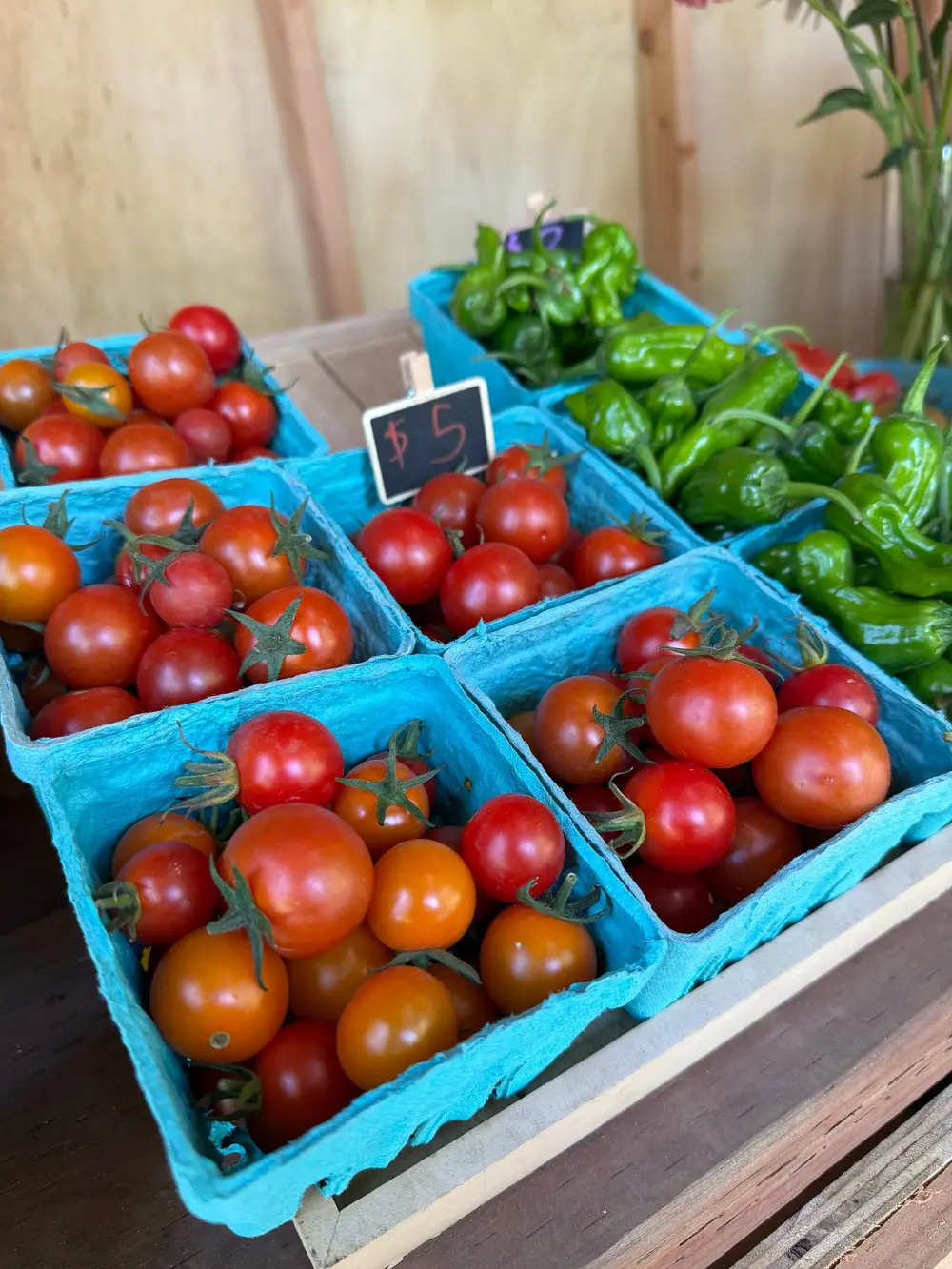
| Sungold tomatoes, by the pint | Roughly midsummer into October |
| Serrano and jalapeño peppers, by the pint | Roughly midsummer into October |
| Dry beans | Late season |
| Pork boxes | Late October |
The stand at 4554 Key Peninsula Hwy NW is open daily, 9am to dusk. Hours vary a lot from stand to stand out here, so check before you drive anywhere else. More on the stand at /farm-stand and directions at /visit.
January
Nothing is being harvested fresh in any quantity. What is around is storage: winter squash, potatoes, onions, and whatever leeks and kale someone left in the ground. Seed catalogues get read and orders go in. The honest note is that our winter cold is not the average, it is the one arctic outbreak that drops us to the bottom of zone 8b, and that can land any time from December to February.
February
Still thin on the shelf. Overwintered kale and leeks, and purple sprouting broccoli in a mild year. Our starts begin now in the hoop house, onions and leeks and brassicas first, and peas can go in outside in a dry window. February here is not cold so much as saturated, and working wet soil does more damage than waiting three weeks would.
March
Overwintered greens, leeks and the first rhubarb turn up late in the month. Peas, spinach, radish and early lettuce go in the ground, and the hoop house fills with brassica and flower starts. WSU calls late March the last frost date for zone 8, and the thermometer disagrees often enough that you should not plant anything tender on the strength of a calendar. Soil temperature is the real gate, and it does not get to the 50°F tomatoes want until about the middle of May.
April
Rhubarb, first cutting greens, and vegetable and flower starts. In the ground go potatoes, more peas, carrots, beets and brassica transplants. Dahlia tubers can start going in after April 15, which is the window the Puget Sound Dahlia Association gives for this region, April 15 to June 1. April looks like spring and is not one. Buy your tomato starts now if you like, but do not put them out.
May
Starts, lettuce, spinach, radish and rhubarb. This is the month everything warm season goes in. WSU King County says to transplant tomatoes once soil is 50°F or above, “typically around the middle of May” (WSU King County), and peppers want it warmer still, so they go last. WSU Skagit calls May magic, and that is about right. The year gets decided in about three weeks.
June
Strawberries, first peas, lettuce, spinach and early broccoli. Succession lettuce and beans go in, winter squash goes in, and fall brassicas get sown at the end of the month. The honest note is that June is grey here more often than people expect, and the warm season, meaning daily highs above 71°F, does not start until about June 23 at Wauna, at the base of the peninsula. Your tomatoes will be green and small and that is normal.
July
Raspberries, blueberries, first zucchini, beans, carrots, new potatoes and garlic. Dahlias start, which the Puget Sound Dahlia Association puts at July through to the first frost, and ours come on with the zinnias. Planting flips to winter: WSU Snohomish says direct seed broccoli and cabbage by mid-July, carrots by mid-July, bush beans by late July (WSU Snohomish). July is our driest month by a wide margin, so water, not heat, is the constraint.
August
Blackberries, sweet corn, cucumbers, summer squash and beans. Our Sungold and our serrano and jalapeño peppers start coming to the stand by the pint. Dahlias are at full tilt. Here is the month where the charts fail hardest: the statewide chart calls August peak tomato season, but with normal lows near 52°F, WSU King County warns that from mid-August “blossoms on large-fruited varieties will not mature and ripen before the end of the season.” Cherry tomatoes ripen here. Beefsteaks often do not, which is exactly why WSU names Sungold as a variety for this climate and why we grow it.
September
The best month of the year on this peninsula, and the one to drive out for. Tomatoes finally arrive in volume, peppers keep coming, and apples, pears, winter squash and corn all land at once. Planting is overwintering spinach, lettuce and mache, plus cover crop. That warm season window closes around September 13, but the fruit that set in August is ripening now, so the stand is fuller in the second half of the month than the first.
October
Winter squash, pumpkins, apples, leeks and root crops, plus the last tomatoes and peppers. Our Sungold and peppers run into October, dry beans come in late, and our first pork boxes go out at the end of the month (/pork). Garlic goes in the ground, WSU Snohomish gives late October to November 10, and fava beans and cover crop follow. The rain comes back around October 9 and dry beans hate it, which is the single hardest thing about growing them west of the Cascades.
November
Storage crops, leeks, Brussels sprouts and kale, which is better after it has been cold. In most years the dahlias are still going, and this is the point where a national chart is a full month behind reality. Planting is garlic to about November 10, fava beans in the second week, and peas in early November for an early June crop. November is also our wettest month, so the flowers may be standing but the ground is done.
December
Storage squash, potatoes, onions, leeks, kale and Brussels sprouts. Almost nothing gets planted. This is usually when the frost finally lands, and once it does the dahlias get cut down to a short stalk and the tubers get dug or mulched. Nine years in ten the first 32°F night has happened by December 10, which is very late by any national standard and the reason the flower season here is longer than anyone expects.
What to tell a visitor in one line
Come in April and May for starts, September and October for food, and July through November for flowers. How we grow all of it is at /how-we-farm.